

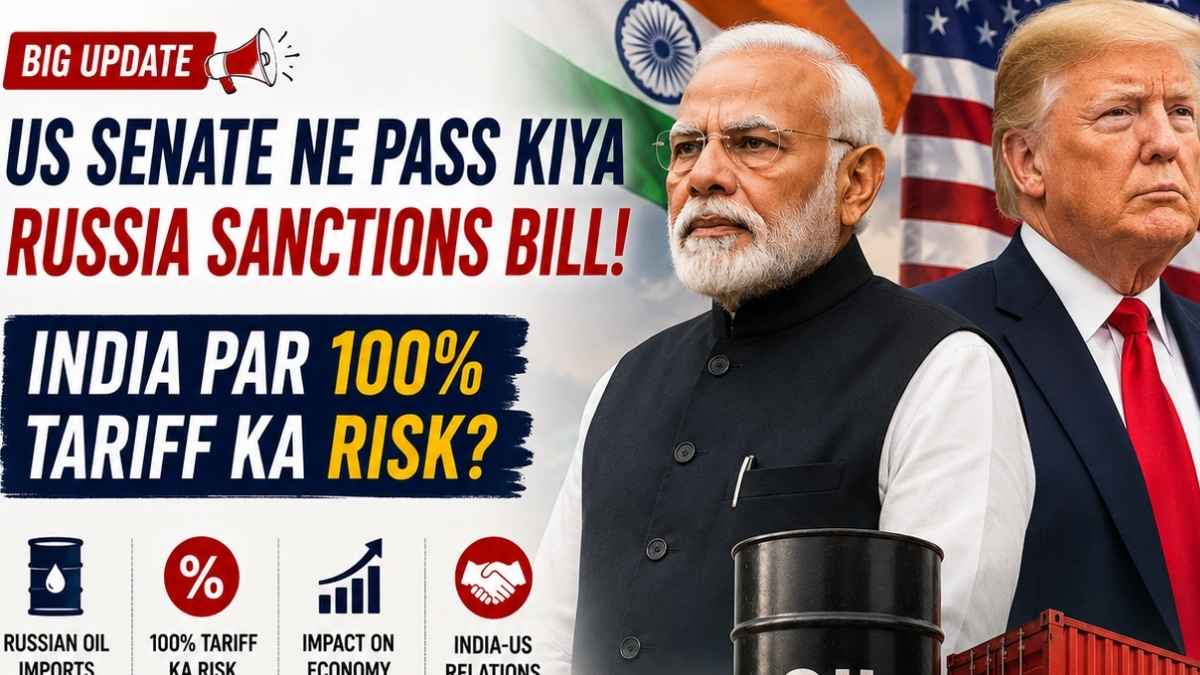
US Senate Passes Russia Sanctions Bill: Why India Is Watching Closely. A new development in Washington has put India's Russian oil purchases, India-US trade relations and global energy markets back under the spotlight. The US Senate has passed legislation aimed at increasing economic pressure on Russia, including a provision that could allow the United States to impose tariffs of up to 100% on countries that continue buying Russian oil and gas.
The bill passed the Senate by a wide margin, but there is an important distinction: the legislation is not itself a 100% tariff on Indian goods. It would create a potential mechanism for such tariffs if the measure becomes law and the relevant powers are subsequently used. India has remained a major buyer of Russian crude oil since the disruption of global energy markets following Russia's invasion of Ukraine. Russian crude has become an important part of India's energy-import strategy, helping Indian refiners access competitive supplies. The latest move in Washington could therefore create a difficult balancing act for New Delhi.
What has happened?
The US Senate approved a Russia sanctions bill by a large majority. The proposed legislation is designed to increase economic pressure on Russia and could give the US administration significant authority to impose additional tariffs on countries continuing to purchase Russian energy. Countries such as India and China, which have been major buyers of Russian crude, could potentially come under scrutiny if the legislation becomes law and the tariff mechanism is activated. However, the bill still has to go through the remaining US legislative process before it becomes law.
Current situation: Senate has passed the legislation.
Not yet: A blanket 100% tariff on Indian goods.
Why is Russian oil so important for India?
India is one of the world's largest oil-consuming economies and imports a substantial portion of its crude requirement. For an economy of India's size, energy prices have a direct effect on almost everything. Crude oil influences petrol and diesel prices, transport costs, airline operating costs, manufacturing, logistics, fertiliser production, inflation, household expenses and India's import bill. Russian crude became particularly attractive to Indian refiners after global energy markets were disrupted. Indian refiners have purchased Russian oil at competitive prices, processed it and supplied petroleum products to domestic and international markets. This has made Russian crude an important part of India's energy strategy.
Why is Washington targeting countries buying Russian energy?
The US argument is essentially that purchasing Russian energy provides Moscow with revenue. The proposed sanctions framework is therefore designed not only to target Russia directly but potentially to put economic pressure on countries continuing significant commercial relationships with Russia's energy sector. New Delhi has maintained that its energy decisions are based on national interest, affordability and energy security. For India, stopping a major source of crude supply is not simply a foreign-policy decision. It could have consequences across the energy chain: energy security, crude prices, inflation and consumers.
What could this mean for India?
The impact depends heavily on what happens next.
Scenario 1 — Negotiations reduce the pressure: India and the US could potentially negotiate around energy purchases and trade, limiting the immediate economic impact.
Scenario 2 — India reduces Russian oil purchases: Indian refiners could increase purchases from other suppliers, although alternative crude may be more expensive depending on global prices, shipping costs and market conditions.
Scenario 3 — US tariffs are imposed: This would be the most serious scenario for Indian exporters. Higher US tariffs could make Indian products more expensive for American consumers and potentially reduce India's competitiveness in the US market. The impact would vary by industry.
Could petrol prices rise in India?
Possibly, but not automatically. Petrol and diesel prices depend on international crude prices, refining margins, currency movements, taxes, domestic pricing policies, supply availability and shipping costs. If replacing Russian crude substantially increases India's average import cost, there could eventually be pressure across the energy chain. But it would be premature to say that the Senate vote alone will make petrol prices jump.
What about the Indian stock market?
Markets generally dislike uncertainty. The development could attract attention from investors because it combines Russia, oil and US trade policy. Sectors that investors may watch include oil and gas, refining, aviation, chemicals, logistics, automobiles, manufacturing and export-oriented companies. Indian exporters with significant US exposure could be particularly sensitive to tariff developments. However, investors should avoid treating the Senate vote itself as a direct buy-or-sell signal. The final legislation, implementation rules and any actual tariff decision will matter much more.India's difficult balancing act. India has spent years building stronger relations with the United States. The two countries cooperate in defence, technology, semiconductor manufacturing, trade, Indo-Pacific security, critical minerals, space and artificial intelligence. At the same time, India maintains a longstanding strategic relationship with Russia. Russia remains important to India in defence equipment, energy, nuclear cooperation and strategic diplomacy. That leaves New Delhi navigating between two important relationships. The Russian oil issue therefore sits at the intersection of energy security, diplomacy, trade and national interest.
One important fact-check
Social media headlines may simplify the story to: “America has imposed 100% tariff on India.” That is not an accurate description of the situation at this stage. A more accurate formulation is: “The US Senate has passed legislation that could enable tariffs of up to 100% on countries continuing to purchase Russian energy, potentially affecting countries such as India if the measure becomes law and is subsequently implemented.” A responsible news report should distinguish between a bill being passed, a law being enacted, authority being exercised and a tariff actually being imposed.
Why this story matters beyond India
The issue could also influence global oil markets. If major buyers reduce purchases of Russian crude, global oil flows could change. Refiners may have to seek alternative suppliers, potentially increasing competition for crude from countries such as Saudi Arabia, Iraq, the UAE, the United States and other major producers. Shipping routes could also change. That means a geopolitical decision in Washington could eventually affect energy markets thousands of kilometres away. The bigger question. The central question now is not simply: “Will India face a 100% tariff?”
The more important question is how India will balance affordable energy, its relationship with Russia and its increasingly important economic relationship with the United States.
The answer could have consequences far beyond diplomacy. For Indian consumers, the issue could eventually influence fuel and inflation. For exporters, it could influence access to the American market. For investors, it could create another source of market uncertainty. And for policymakers, it represents another difficult foreign-policy balancing act.
For now, however, the situation remains a developing policy and legislative story—not a blanket 100% tariff imposed on India.